
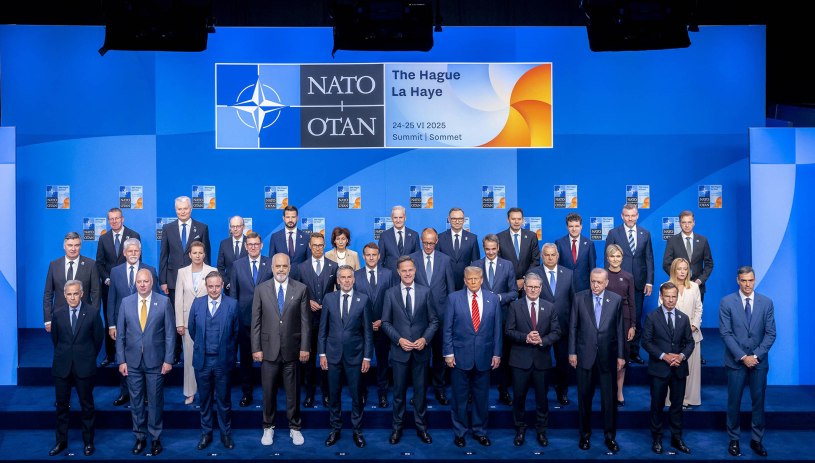
Intro
At the NATO Summit in The Hague, Allies committed to spending 5% of GDP on defense by 2035. This historic pledge marks a dramatic shift, but also a deepening divide. Under mounting U.S. pressure, Europe faces a new strategic reality where cohesion, capacity, and influence are all at stake.
Executive Summary
The NATO Summit held in The Hague on 24–25 June 2025 marked a strategic turning point for the Alliance. Under visible U.S. pressure, particularly from President Trump, the Allies adopted a new collective defence spending target of 5% of GDP by 2035. This represents a dramatic shift in NATO’s post-Cold War trajectory and places the burden of strategic adaptation squarely on European shoulders. Meanwhile, Ukraine’s marginal presence at the Summit, and growing attention toward Indo-Pacific partnerships, signal a broader redefinition of NATO’s global posture.
NEWS60 Assessment
The Summit confirmed that NATO is no longer driven by a transatlantic consensus but shaped by a U.S.-dominated agenda that prioritizes defence industrial mobilization, readiness, and strategic competition with China. The decision to raise defence spending to 5% is historic, but also divisive. It risks fragmenting Europe’s cohesion, overburdening weaker economies, and further exposing Europe’s dependence on U.S. political will. Turkiye and the UK are poised to play outsized roles in this new era, while France appears increasingly at odds with NATO’s long-term direction.
Strategic Importance
A 5% Benchmark with No Precedent:
The decision to adopt 5% of GDP as a defence spending benchmark is the most ambitious in NATO history. It goes beyond the 2% target agreed in 2014 and signals a U.S.-led push for continuous military and industrial readiness. While some Allies, such as Poland or Estonia, are on track, many Western European countries remain well below this threshold.
Trump’s Influence on NATO’s Direction:
The Summit outcome reflects a direct response to President Trump’s demands. Unlike past NATO meetings, which balanced priorities, The Hague Summit displayed clear political asymmetry. Trump’s leadership overshadowed both the Secretary General and European counterparts, setting the tone for policy announcements and narrative framing.
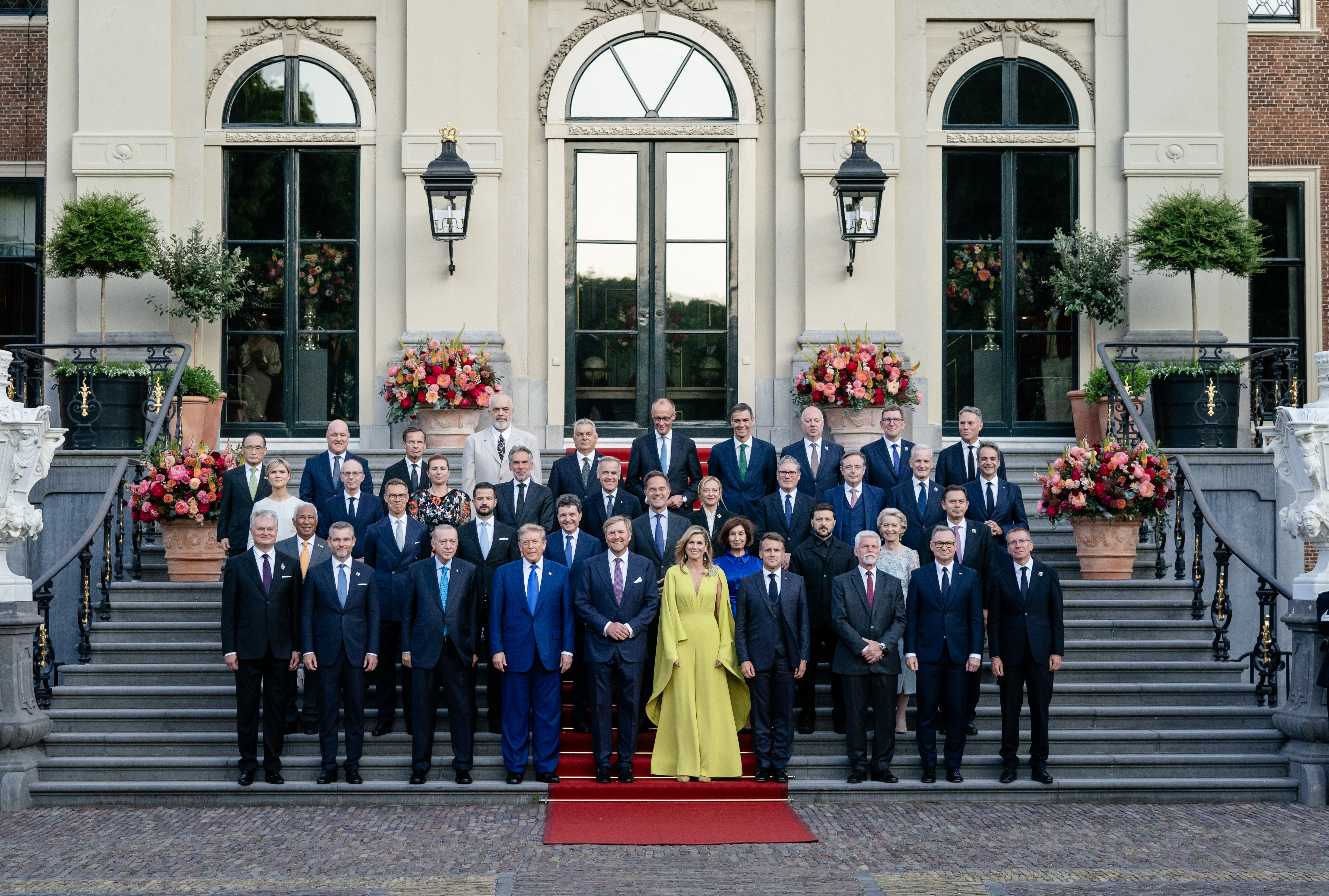
A snapshot of shifting transatlantic dynamics
Ukraine Sidelined:
Ukrainian President Zelensky’s limited participation was symbolic. There were no major announcements on Ukraine’s accession, and the support provided was repackaged within the new 5% metric. NATO’s shift from “Ukraine first” to “Ukraine long-term partner” suggests growing fatigue and strategic reprioritization within the Alliance.
Turkiye and the UK Emerging as Pillars:
As internal divisions within the EU-NATO axis deepen, non-EU Allies are gaining ground. The UK, freed from EU constraints, aligns closely with the U.S. push for strategic reach. Turkiye, meanwhile, is set to host the 2026 Summit, an event likely to elevate Ankara’s geopolitical leverage and reinforce its role as NATO’s southern flank.
France’s Discomfort Re-Emerges:
France has long harboured reservations toward NATO’s U.S.-centric policies. At The Hague, President Macron’s discomfort was apparent, as Paris remains far from the 5% pledge and continues to advocate for EU strategic autonomy. This divergence could accelerate internal frictions within the Alliance’s western bloc.
Implications
Structural Shift toward U.S.-led Industrial NATO:
NATO is evolving from a political-military alliance into a hybrid industrial-security bloc. The 5% pledge includes investments in cyber defence, innovation, and infrastructure, not just conventional forces. This redefines the role of partners and opens the door to new forms of cooperation, especially with the Indo-Pacific.
Mounting Pressure on Southern Europe:
Countries like Spain, Italy, and Portugal are struggling to reach even 2%. The new target will increase internal strain, widen defence capacity gaps, and raise questions about burden-sharing and strategic equality within the Alliance.
Strategic Marginalization of the EU:
The European Union was notably absent from NATO’s core deliberations, with no formal presence in the Summit’s conclusions. This raises concerns over NATO-EU coordination at a time of converging crises and will likely deepen Europe’s strategic dependence on U.S. leadership.
Moscow Could Read NATO’s Posture as Weakness:
The lack of escalation toward Russia, no fast-tracked Ukrainian membership, no major eastern deployments, may embolden the Kremlin. Moscow could interpret NATO’s hesitation as a strategic vacuum, increasing the risk of further testing of NATO’s eastern flank.
Strategic Scenarios (2025–2035)
Scenario 1: Trump Doctrine Consolidates (Most Likely)
If the Republicans win re-election in 2028, the 5% target becomes the core of NATO’s strategic identity. Defence becomes synonymous with industrial and economic competitiveness. Countries unable to keep pace, like Spain or France, lose influence. NATO evolves into a U.S.-anchored bloc with global partnerships, notably in the Indo-Pacific. Germany, Turkiye and the UK act as balancing middle powers.
Scenario 2: Democratic Administration in 2029 (Moderately Likely)
A change in the White House may moderate the pace, but not reverse the trajectory. The 5% benchmark remains a reference, but flexibility returns. EU-NATO cooperation is revived, and France regains space to promote its concept of strategic autonomy. Ukraine could benefit from renewed attention, but NATO’s global expansion slows.
Scenario 3: European Pushback Escalates (Less Likely)
By 2028, a critical mass of European countries, led by France, will begin resisting the 5% target. Institutional crises erupt. NATO’s unity fractures between Atlanticists and Continental Europeans. The result: a two-speed NATO with different levels of commitment and strategic alignment.
Conclusion
The NATO 2025 Summit institutionalized U.S. political dominance within the Alliance. The 5% pledge is more than a financial goal, it is a geopolitical tool. While the move enhances military readiness, it also reveals growing asymmetries within NATO. Europe’s political fragmentation, combined with the sidelining of Ukraine and the EU, suggests that NATO’s future depends less on geography and more on strategic will, and that will increasingly reside in Washington.

