
Diplomatic Compass · Edition No. 10 · 16 September 2026 · By Hafsa M. Temsamani, PhD
Editorial
The strategic debate within NATO is increasingly shifting from commitments to delivery. Following the Ankara Summit, the focus is on translating greater European and Canadian responsibility and higher defence investment into the capabilities, readiness and industrial capacity required for credible deterrence and defence.
This is central to NATO 3.0: a stronger Europe in a stronger NATO, with European Allies and Canada assuming greater responsibility for the Alliance’s defence. Delivering on the 5% commitment by 2035 is not simply about spending more, but about converting investment into capability, strengthening interoperability and resilience, and sustaining collective defence.
Across the issues examined in this edition, from Ukraine and the High North to CBRN preparedness, counter-terrorism and developments in the Southern Neighbourhood, the underlying policy challenge is one of delivery: turning commitments into capability and national resilience into collective effect.
Spotlight
25 Years After 9/11. Terrorism, Article 5 and Allied Solidarity
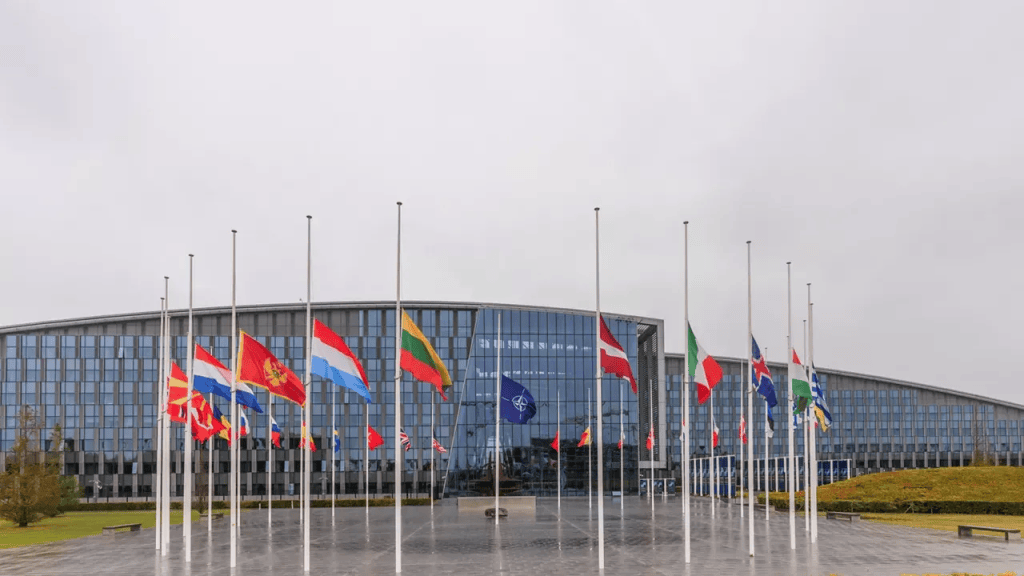
On 11 September 2026, NATO marked the 25th anniversary of the 9/11 terrorist attacks against the United States at NATO Headquarters in Brussels. The anniversary recalled the first and only invocation of Article 5, underscoring the enduring link between Allied solidarity, collective defence and NATO’s response to terrorism. Twenty-five years later, terrorism remains a persistent security threat, reinforcing the need for political cohesion, military readiness and sustained cooperation with partners as the threat environment evolves.
Key Strategic Takeaways
- Article 5 and Terrorism: The response to 9/11 demonstrated that collective defence can apply beyond conventional interstate aggression to major asymmetric threats.
- Terrorism Remains a Persistent Threat: Twenty-five years later, counter-terrorism continues to require sustained preparedness, intelligence, capabilities and resilience across the Alliance.
- Partnerships are Essential to Counter-Terrorism: Terrorism and violent extremism transcend borders; effective prevention and response depend on sustained cooperation with partners, including through shared awareness, capacity-building and efforts to counter extremism and violent extremism.
I. NATO Affairs
NATO 3.0: Rebalancing Responsibility within a Stronger Alliance
NATO 3.0 is taking shape as a broader reconfiguration of responsibility within the Alliance, with European Allies and Canada expected to assume a greater share of their own security while maintaining the United States as an indispensable transatlantic partner. Speaking in Berlin on 10 September 2026, NATO Secretary General Mark Rutte described this shift as the most profound transformation of the Alliance since the Cold War, arguing that security should no longer be understood as something the United States provides for Europe, but rather as a responsibility exercised with Europe. The emerging model therefore goes beyond traditional burden-sharing: it concerns greater European and Canadian responsibility for force generation, readiness, capability delivery and collective defence within the Alliance.
The implications for NATO are structural. A stronger European contribution must translate into higher readiness, credible forward defence, expanded industrial capacity and the ability to sustain collective defence over time. Germany’s permanent brigade in Lithuania, Allied command arrangements on the eastern flank and growing defence-industrial output provide concrete illustrations of this wider transformation, but NATO 3.0 is inherently Alliance-wide. Russia’s continued aggression against Ukraine and hybrid pressure against Allied territory further underline that greater European and Canadian responsibility must reinforce, not fragment, the transatlantic framework and NATO’s ability to deter, defend and respond across the full spectrum of threats.
Key Strategic Takeaways
- A Rebalanced Transatlantic Responsibility: NATO 3.0 points towards a more distributed model in which European Allies and Canada assume greater responsibility for collective defence while preserving sustained U.S. engagement.
- Beyond Burden-Sharing: The transformation is not limited to defence expenditure; it extends to force generation, readiness, operational responsibility and the capacity to deliver military effect.
- A Stronger European Pillar within NATO: Greater European responsibility is intended to reinforce the Alliance rather than create a separate security architecture, strengthening the overall credibility of transatlantic deterrence and defence.
- Industrial Capacity as Strategic Depth: Defence production, stock regeneration and industrial resilience are increasingly central to NATO’s ability to implement defence plans and sustain high-intensity operations.
- NATO 3.0 as Alliance Adaptation: The central test will be whether the redistribution of responsibility produces a more capable, resilient and operationally credible Alliance without weakening cohesion across the Atlantic.
II. Transatlantic Security
U.S. CBRN Preparedness: Implications for Allied Defence and Resilience
Published on 4 September 2026, a new U.S. interagency agreement between the Department of War and the National Institutes of Health establishes a long-term framework to accelerate the development and acquisition of countermeasures against chemical, biological, radiological and nuclear (CBRN) threats. The arrangement connects scientific and technological expertise with defence acquisition, rapid threat assessment, detection, physical protection and operational requirements, strengthening the pathway from research and innovation to deployable CBRN capability.
Beyond the U.S. context, the initiative has wider implications for Allied defence planning. NATO already treats strengthened CBRN military capabilities and national resilience as mutually reinforcing elements of deterrence and defence. The policy challenge is therefore increasingly one of delivery: ensuring that national investments in innovation, preparedness and capability development translate into interoperable forces, effective force protection and sustained operational effectiveness across the Alliance. The U.S. approach provides a relevant reference point for the wider transatlantic debate on how European and Canadian Allies can better connect technological innovation, acquisition and operational requirements while reinforcing NATO-wide preparedness against evolving CBRN threats.
Key Strategic Takeaways
- CBRN Defence as an Enabler of Deterrence and Defence: CBRN preparedness increasingly extends beyond consequence management, contributing directly to military readiness, force protection and the credibility of Allied deterrence and defence.
- From Innovation to Operational Capability: The U.S. initiative illustrates the strategic value of connecting research, technology and acquisition more directly with operational requirements, reducing the distance between emerging solutions and deployable capabilities.
- Resilience and Military Readiness as Mutually Reinforcing: Effective CBRN defence requires both robust military capabilities and resilient national structures capable of sustaining operations and responding to disruption across the crisis continuum.
- Interoperability as an Allied Requirement: As CBRN threats cross national boundaries, preparedness increasingly depends on interoperable capabilities, common standards, coordinated planning and the ability of Allies to operate effectively together in contested environments.
- Transatlantic Capability Challenge: The wider policy implication for NATO is how the United States, Canada and European Allies can strengthen national CBRN capabilities while ensuring that these investments contribute to a coherent, resilient and interoperable Alliance-wide posture.
III. NATO-EU Cooperation
Ukraine Support: From Political Commitment to Capability Delivery
Support to Ukraine is increasingly moving from political commitment towards an integrated capability-delivery architecture linking European financing, NATO and Allied mechanisms, partner contributions and U.S. defence capabilities. At the Ukraine Defence Contact Group meeting on 8 September 2026, NATO Secretary General Mark Rutte highlighted more than USD 10 billion allocated over the past year through PURL and U.S. Foreign Military Sales, including USD 3.5 billion from the EU’s Ukraine Support Loan. He described this as a tangible example of NATO–EU cooperation and of Europe stepping up, while stressing the urgency of sustaining deliveries of critical equipment, including air defence, to Ukraine.
The policy significance lies in how these instruments increasingly complement one another. EU financial capacity can support access to critical capabilities, while NATO, Allies and partners contribute coordination, procurement pathways and operational relevance. The central challenge is therefore no longer only the scale of political or financial support, but the ability to convert resources into timely, sustainable and operationally relevant capability. This places procurement speed, industrial capacity, continuity of supply and responsiveness to battlefield requirements at the centre of NATO-EU support planning.
Key Strategic Takeaways
- From Commitment to Capability Delivery: Support to Ukraine is increasingly measured not by political pledges alone, but by the speed at which financing is converted into operationally relevant military capability.
- NATO-EU Complementarity in Practice: EU financing combined with NATO, Allied and partner delivery mechanisms demonstrates how the two organisations can generate complementary strategic effect while preserving their respective roles.
- Europe Stepping Up: Increased European financial contributions reinforce burden-sharing while maintaining access to critical U.S. military capabilities required to meet Ukraine’s immediate operational needs.
- PURL as a Transatlantic Capability Bridge: By enabling Allies and partners to finance U.S. military equipment for Ukraine, PURL connects North American defence capacity, European resources and Ukrainian battlefield requirements.
- Speed and Sustainability as Strategic Requirements: Sustaining Ukraine’s defence requires predictable financing, continuous procurement, industrial availability and timely delivery; delays directly affect operational effectiveness and Ukraine’s ability to defend its population and hold the front line.
IV. Belgium’s Defence Ecosystem
Belgian Defence in NATO’s High North Air Defence Posture
Belgium’s deployment of F-16s to Iceland places Belgian Defence directly within NATO’s evolving deterrence and defence posture in the High North. In its 31 August 2026 operational update, Belgian Defence highlighted Iceland’s strategic position at the intersection of Europe, North America and the Arctic, where critical air and maritime routes converge. Operating from Keflavik under NATO command, Belgian aircraft and personnel contributed to air surveillance and Quick Reaction Alert responsibilities, reinforcing Allied readiness across the North Atlantic at a time when the High North is acquiring increasing importance for collective defence.
The deployment is significant beyond the rotation itself. NATO Allied Air Command is progressively moving from traditional Air Policing towards a more integrated air and missile defence posture, combining aircraft, command-and-control, air and missile defence systems and counter-UAS capabilities within a layered 360-degree approach. Belgium’s contribution illustrates how national forces can be integrated into this wider architecture, translating national capability into operational effect for the Alliance. Belgian F-16s are also participating in Northern Viking, strengthening Allied cooperation, readiness and interoperability in the strategically important North Atlantic and High North environment.
Key Strategic Takeaways
- The High North as a Transatlantic Security Space: Iceland’s strategic location connects the European and North American pillars of the Alliance and gives air and maritime security in the region direct relevance to reinforcement, deterrence and collective defence.
- Belgian Defence in NATO’s Operational Posture: The deployment demonstrates how Belgian Defence contributes directly to NATO readiness and collective defence, deploying national air capabilities beyond Belgium’s immediate geographic environment within an Allied command structure.
- From Air Policing to Integrated Air Defence: The mission reflects NATO’s broader evolution towards a layered air and missile defence posture capable of integrating multiple capabilities against an increasingly complex spectrum of aerial threats.
- National Capabilities, Alliance-Wide Effect: Belgium’s contribution illustrates how national assets acquire wider strategic value when incorporated into NATO planning, command-and-control and collective defence arrangements.
- From Industrial Capacity to Operational Capability: Following Edition No. 8’s focus on Belgium’s entry into the F-35 industrial ecosystem, the Iceland deployment highlights the operational side of defence adaptation: Belgian Defence translating investment, capability and readiness into a concrete contribution to NATO deterrence and defence.
V. Southern Neighbourhood
From Hormuz to Bab al-Mandeb: Strategic Chokepoints Under Pressure
The recent deterioration of maritime security from the Strait of Hormuz to Bab al-Mandeb is turning one of the Ankara Summit’s core Southern-security concerns into an immediate policy-planning challenge for the Alliance. The 2026 Ankara Summit Declaration reaffirmed NATO’s 360-degree approach, identified terrorism and pervasive instability among the threats shaping the broader security environment, and explicitly called on Iran to respect freedom of navigation in the Strait of Hormuz. Two months later, disruption around Hormuz is being compounded by the rapid advance of the Iran-aligned Houthis along Yemen’s Red Sea coast and onto Perim Island, increasing pressure on a second strategic maritime gateway.
The emerging challenge is broader than the security of two waterways. Simultaneous pressure across Hormuz and Bab al-Mandeb is creating a connected strategic environment in which Iranian regional leverage, armed non-state actors, terrorism, maritime coercion, energy security and critical infrastructure increasingly intersect. This risk is further amplified by the diffusion of advanced technologies: recent threat reporting identified a northern Yemen-based guided-weapons engineering cell using generative AI to support the development of guidance, navigation and control software for guided weapons. Anthropic reported no evidence that the actors succeeded in fielding an operational device, although they did test-fire a guided rocket that appears to have failed. The case nevertheless illustrates how generative AI may lower technical barriers and compress development cycles for armed non-state actors
For NATO, the significance lies in the potential transmission of these risks into the Euro-Atlantic security environment through disruption of strategic sea lines of communication, pressure on energy and commercial flows, technological proliferation and increased exposure of critical infrastructure and supply chains. The policy-planning requirement is therefore not to treat Southern instability as a geographically contained contingency, but to integrate strategic access, maritime resilience, counter-terrorism, emerging technology and preparedness more systematically within NATO’s 360-degree assessment of the security environment.
Key Strategic Takeaways
- Two Chokepoints, One Strategic System: Hormuz and Bab al-Mandeb should increasingly be assessed as interdependent components of the wider Gulf-Red Sea security architecture; disruption in one corridor increases dependence on, and vulnerability in, the other.
- Maritime Security and Counter-Terrorism are Converging: The capacity of armed non-state actors to generate strategic effects around critical sea lanes increasingly connects terrorism, maritime security, freedom of navigation and critical-infrastructure protection.
- AI-Enabled Capability Diffusion: The use of commercially available generative AI in weapons engineering introduces a new proliferation dynamic, potentially lowering technical barriers, accelerating development cycles and expanding the military capabilities available to non-state actors.
- The Southern Neighbourhood as a 360-Degree Security Requirement: Instability south of the Alliance can produce direct consequences for Allied resilience, strategic access, energy security and the continuity of critical supply chains.
- From Strategic Recognition to Preparedness: The policy challenge following Ankara is to translate recognition of Southern risks into sustained situational awareness, anticipatory planning and resilience while preserving NATO’s core deterrence and collective-defence mandate.
VI. Policy Brief
NATO Counter-Terrorism and Belgium’s New Article 376: From National Resilience to Allied Security
Much of the counter-terrorism capacity that keeps the Alliance secure is built at national level. This Diplomatic Compass Policy Brief examines that link through Belgium’s new Article 376, the offence of publicly glorifying terrorism, in force since 1 September 2026, and asks how national frameworks strengthen NATO’s approach to resilience and Allied security, without over-reaching into protected speech.
Closing Note
This concludes Edition No. 10 of the Diplomatic Compass Newsletter. Thank you for reading and for your continued engagement.
📩 Share this edition with someone who should be reading it.
Subscribe to the Diplomatic Compass Review
Independent perspectives on NATO, defence and security, delivered to your inbox.

